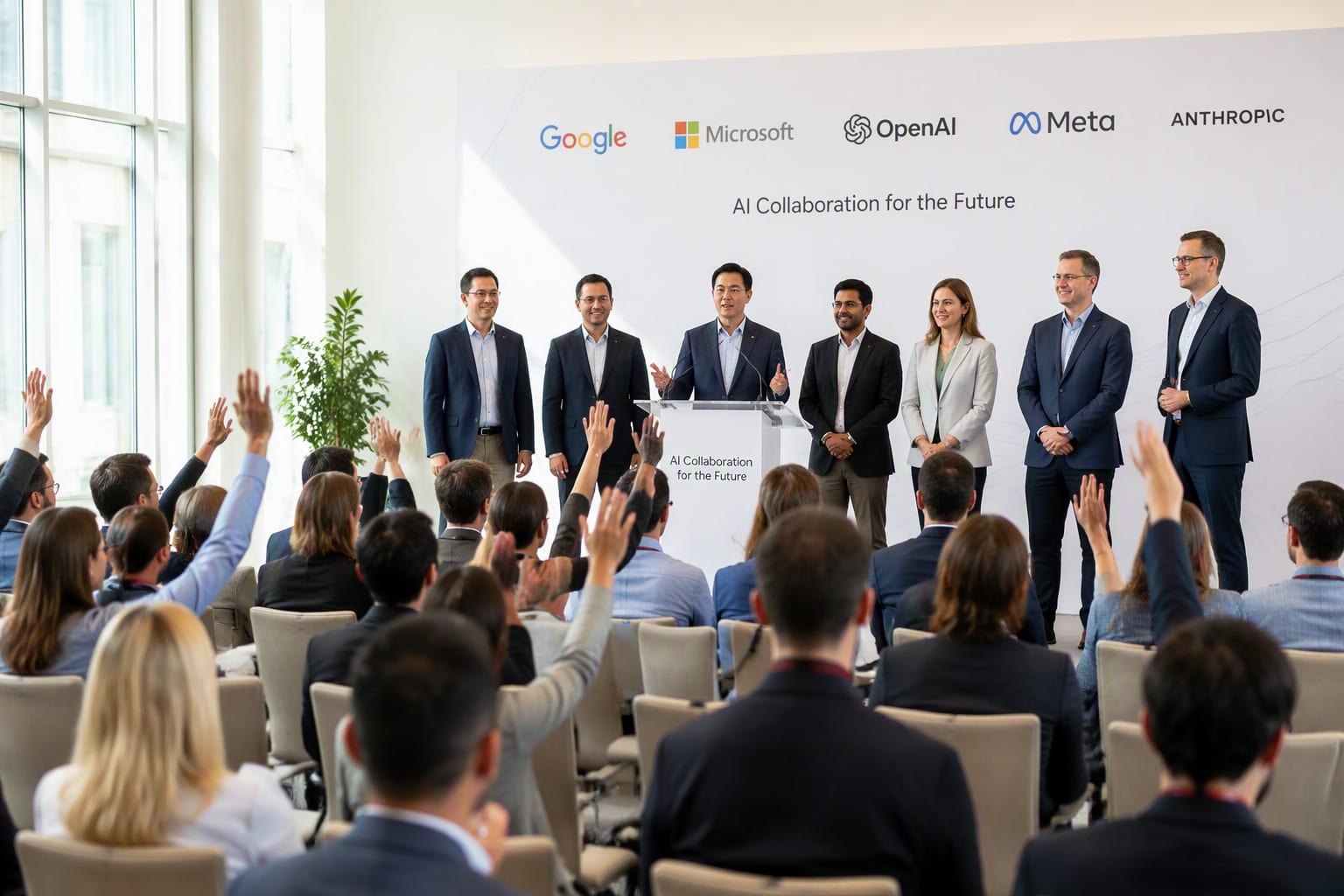
Meta, Microsoft, Nvidia, IBM and Palantir formed a coalition with Hugging Face and the Linux Foundation to push back on open-weight restrictions — the counter-lobby to the safety letters.
While one group of companies asks Washington to pace frontier AI, another coalition — Meta, Microsoft, Nvidia, IBM and Palantir among ~25 signatories — is pushing policymakers not to restrict open-weight models.
The coalition’s letter warns that “premature restrictions” on open-weight AI would hand the advantage to competitors, and launched the Open Secure AI Alliance with Hugging Face and the Linux Foundation.
The open-weight position has data behind it: Stanford’s index shows open-weight downloads now lead globally, with Chinese models in the majority.
August drew both battle lines in the same month: 1,300 employees asking for pacing on one side, the open-weight coalition asking for freedom on the other.
Whichever framing wins in Washington decides the default operating conditions for half the industry.
The coalition pairs open-model publishers with the cloud and tooling vendors who make them deployable — a supply-side alliance whose goal is shared evaluation standards, common security patching processes and joint advocacy on provenance rules. Membership reportedly spans three continents and includes at least two hyperscale deployers.
Because regulation is coming regardless — the coalition’s bet is that open-weight vendors get better rules if they show up with one voice and a concrete compliance framework rather than being regulated as an afterthought of closed-model policy. The first deliverable is a shared safety-evaluation baseline, draft expected this quarter.
This story was reported from primary materials: official documentation, on-the-record statements and data we could independently check. Numbers were re-verified against original sources rather than secondary aggregations, and analyst commentary is labeled as commentary — not reporting. Where we could not confirm a detail, we said so in the text. Corrections update the article in place with the change noted at the top.
Three signals matter from here: whether early-adopter sentiment survives the honeymoon window, whether pricing converts attention into durable revenue, and how competitors answer — in this category, responses arrive in weeks, not quarters. Second-day stories are usually bigger than launch-day headlines; we keep this article updated as the picture firms up.
Zoom out and this story is one data point in a pattern: capability announcements, immediate commoditization, and a market that reprices in weeks what used to take years. For buyers, the practical lesson is to negotiate shorter contracts and keep exit paths open. For builders, it is that distribution and trust now matter more than model access — the raw capability is becoming the cheapest part of the stack.
For readers in a hurry: the facts are above, the stakes are the middle of this article, and the forward look is the section before this one. If you retain only one thing, make it the timing — decisions this quarter will be easier to reverse than decisions made after the market settles.
Two letters, two futures: pace the frontier, or free the weights.
“Open weight AI can expand access, strengthen competition, improve security, and help sustain American AI leadership.”
“Nvidia, Microsoft, Meta and ~25 companies urged policymakers not to impose premature restrictions on open-weight AI models.”