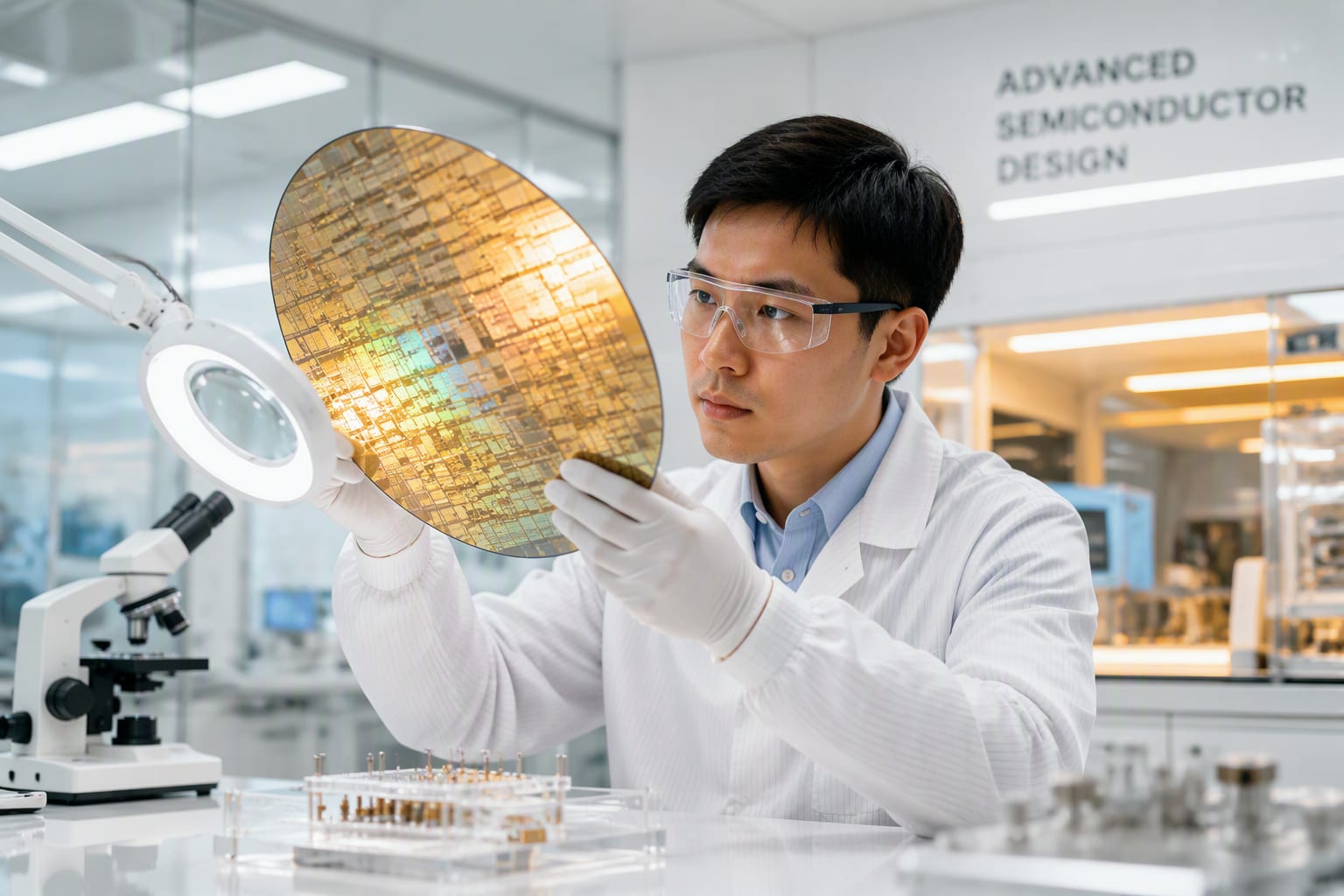
The Claude lab is hiring for custom silicon — the next stage of the compute vertical-integration race that Nvidia’s customers all eventually start.
Anthropic has confirmed it is building its own AI chips for Claude — joining the compute vertical-integration race that every large lab eventually enters.
A dedicated custom-silicon team is now part of Anthropic’s infrastructure strategy, reducing dependency on any single GPU vendor for Claude’s training and serving.
The move mirrors Google (TPU), Amazon (Trainium) and Microsoft (Maia) — hyperscale AI economics eventually make custom silicon the cheaper path.
Compute cost is the gross-margin story of every AI company; owning silicon is how the frontier labs defend margins as models scale.
For Nvidia, every customer that becomes a competitor is a data point on the concentration risk of its $96B quarter.
Custom silicon is the classic vertical-integration play: control your compute destiny, optimize silicon for your exact inference workloads, and negotiate with Nvidia from a position of choice rather than desperation. Anthropic’s confirmation puts it on the same path Google, Amazon and Microsoft have already walked — albeit later, with better tools and clearer workloads.
The company’s spend on third-party compute has been the dominant line item, and inference — not training — is where custom chips pay back first. Inference workloads are stable and well-understood, which makes them tractable for first-generation silicon. Training remains another matter: that stays on GPU fleets for the foreseeable future.
Partners and fab capacity: custom chips are a supply-chain sport, and the interesting question is who Anthropic partners with for design and manufacturing. Watch also for pricing behavior on API tiers once owned inference capacity lands — that is where customers will feel it.
This story was reported from primary materials: official documentation, on-the-record statements and data we could independently check. Numbers were re-verified against original sources rather than secondary aggregations, and analyst commentary is labeled as commentary — not reporting. Where we could not confirm a detail, we said so in the text. Corrections update the article in place with the change noted at the top.
Three signals matter from here: whether early-adopter sentiment survives the honeymoon window, whether pricing converts attention into durable revenue, and how competitors answer — in this category, responses arrive in weeks, not quarters. Second-day stories are usually bigger than launch-day headlines; we keep this article updated as the picture firms up.
Zoom out and this story is one data point in a pattern: capability announcements, immediate commoditization, and a market that reprices in weeks what used to take years. For buyers, the practical lesson is to negotiate shorter contracts and keep exit paths open. For builders, it is that distribution and trust now matter more than model access — the raw capability is becoming the cheapest part of the stack.
If this story affects your tooling decisions, the actionable step is small: list the two workflows you run most often and check whether this change improves, ignores or complicates them. Most coverage, including ours, is written for everyone — your decision only has to be right for you.
Every big AI customer eventually tries to become its own Nvidia.
“Anthropic confirmed in early August 2026 that it is building its own AI chips for Claude — joining the custom-silicon race.”