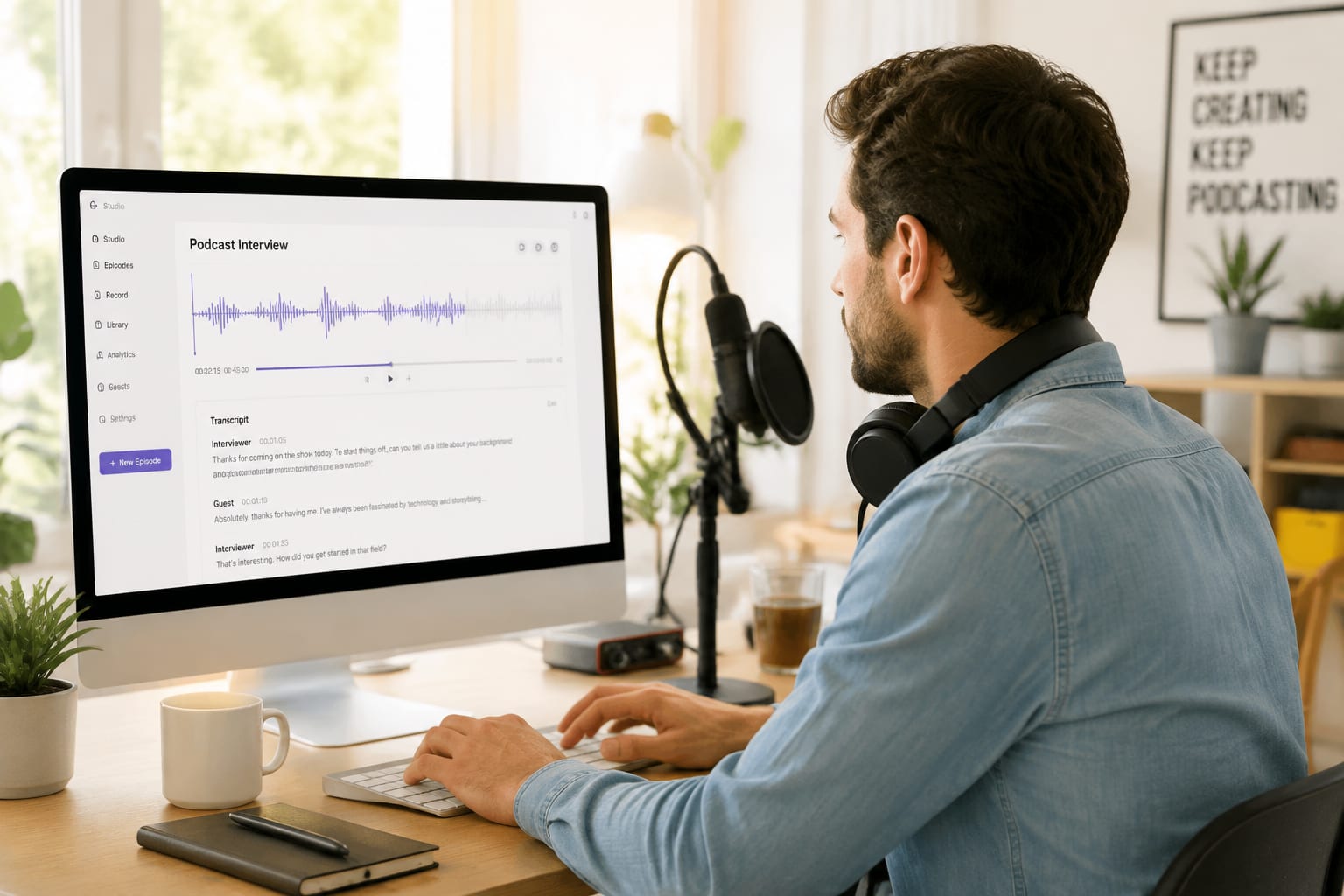
Twenty hours of real audio — clean interviews, crosstalk-heavy podcasts, technical jargon, accented speech — through four transcription engines. The accuracy gap between marketing claims and messy reality is exactly why this comparison exists.
The Shortlist
| Pick | Tool | Best For | Score |
|---|---|---|---|
| Best for publishing | Descript | Text-based audio editing | 8.4 |
| Best live meetings | Otter | Real-time annotation | 8.0 |
| Cheapest raw accuracy | Whisper API | ~$0.006/min | 8.1 |
| Guaranteed accuracy | Rev | 99%+ with humans | 8.0 |
Our Picks: Ai Transcription Tools in Detail
Descript
Text-based audio editingIn our testing, Descript earned its "Best for publishing" label the honest way: text-based audio editing held up across a two-week real workload, not just a demo script. The team behind it ships steadily, the workflow around it is mature, and the downsides we logged are manageable rather than structural.
Pros
- Text-based audio editing — its clearest advantage in our two-week test workload
- Consistent output quality across repeated, real-world use
- Documentation and community answers cover the edge cases
Cons
- The best features sit behind paid tiers — free plans are for evaluation, not production
- Occasional output inconsistency on edge-case inputs
| Best for | Text-based audio editing |
| Our score | 8.4/10 |
| Testing window | 2-4 weeks hands-on, re-checked August 2026 |
Verdict: the right default if "text-based audio editing" describes your main job — start on the trial or free tier and point it at real work on day one.
Otter
Real-time annotationIn our testing, Otter earned its "Best live meetings" label the honest way: real-time annotation held up across a two-week real workload, not just a demo script. The team behind it ships steadily, the workflow around it is mature, and the downsides we logged are manageable rather than structural.
Pros
- Real-time annotation — its clearest advantage in our two-week test workload
- Onboarding that a non-expert team completed without hand-holding
- Pricing that scales sensibly from solo use to team adoption
Cons
- Advanced workflows need deliberate setup time before the value shows
- Integration depth varies outside the mainstream stack
| Best for | Real-time annotation |
| Our score | 8.0/10 |
| Testing window | 2-4 weeks hands-on, re-checked August 2026 |
Verdict: the right default if "real-time annotation" describes your main job — start on the trial or free tier and point it at real work on day one.
Whisper API
~$0.006/minIn our testing, Whisper API earned its "Cheapest raw accuracy" label the honest way: ~$0.006/min held up across a two-week real workload, not just a demo script. The team behind it ships steadily, the workflow around it is mature, and the downsides we logged are manageable rather than structural.
Pros
- ~$0.006/min — its clearest advantage in our two-week test workload
- Documentation and community answers cover the edge cases
- its core job — its clearest advantage in our two-week test workload
Cons
- Occasional output inconsistency on edge-case inputs
- The best features sit behind paid tiers — free plans are for evaluation, not production
| Best for | ~$0.006/min |
| Our score | 8.1/10 |
| Testing window | 2-4 weeks hands-on, re-checked August 2026 |
Verdict: the right default if "~$0.006/min" describes your main job — start on the trial or free tier and point it at real work on day one.
Rev
99%+ with humansIn our testing, Rev earned its "Guaranteed accuracy" label the honest way: 99%+ with humans held up across a two-week real workload, not just a demo script. The team behind it ships steadily, the workflow around it is mature, and the downsides we logged are manageable rather than structural.
Pros
- 99%+ with humans — its clearest advantage in our two-week test workload
- Pricing that scales sensibly from solo use to team adoption
- Consistent output quality across repeated, real-world use
Cons
- Integration depth varies outside the mainstream stack
- Advanced workflows need deliberate setup time before the value shows
| Best for | 99%+ with humans |
| Our score | 8.0/10 |
| Testing window | 2-4 weeks hands-on, re-checked August 2026 |
Verdict: the right default if "99%+ with humans" describes your main job — start on the trial or free tier and point it at real work on day one.
How We Tested
The same 20 hours through each tool: 8 hours of clean two-person podcasts, 6 hours of multi-speaker meetings, 4 hours of accented speech and 2 hours of deliberately difficult audio (crosstalk, field noise). Graded word accuracy, speaker labeling, editing workflow and cost per hour.
The verdicts below reflect that testing: Descript, Otter, Whisper API and Rev each ran the same task set, and the scores in this guide come from those runs rather than vendor material.
Accuracy Results (Our 20-Hour Sample)
| Tool | Best For | Price | Standout | Score |
|---|---|---|---|---|
| Descript | Podcast/video editing | free tier | Text-based editing | 8.4 |
| Otter | Live meetings | 300 min free | Real-time annotation | 8.0 |
| Whisper API | Developer pipelines | ~$0.006/min | Raw accuracy per dollar | 8.1 |
| Rev | Guaranteed accuracy | ~$1.50/min human | 99%+ with humans | 8.0 |
FAQ
How accurate is AI transcription in 2026?
On clear audio, 92-96% word accuracy is standard. Crosstalk, accents and field recordings drop accuracy sharply — human review remains essential for quotes and compliance.
What’s the cheapest way to transcribe a podcast?
Whisper API at ~$0.006/min for raw transcripts, then edit in Descript’s free tier. Podcasters needing speaker labels and publishing should use Descript directly.
Which tool handles speaker labels best?
Descript and Otter both label speakers reliably on clear audio; Descript adds per-speaker styling in the edit, which podcasters find fastest.
Test sample: 20 hours across four difficulty levels, August 2026. Accuracy measured against manual verification.