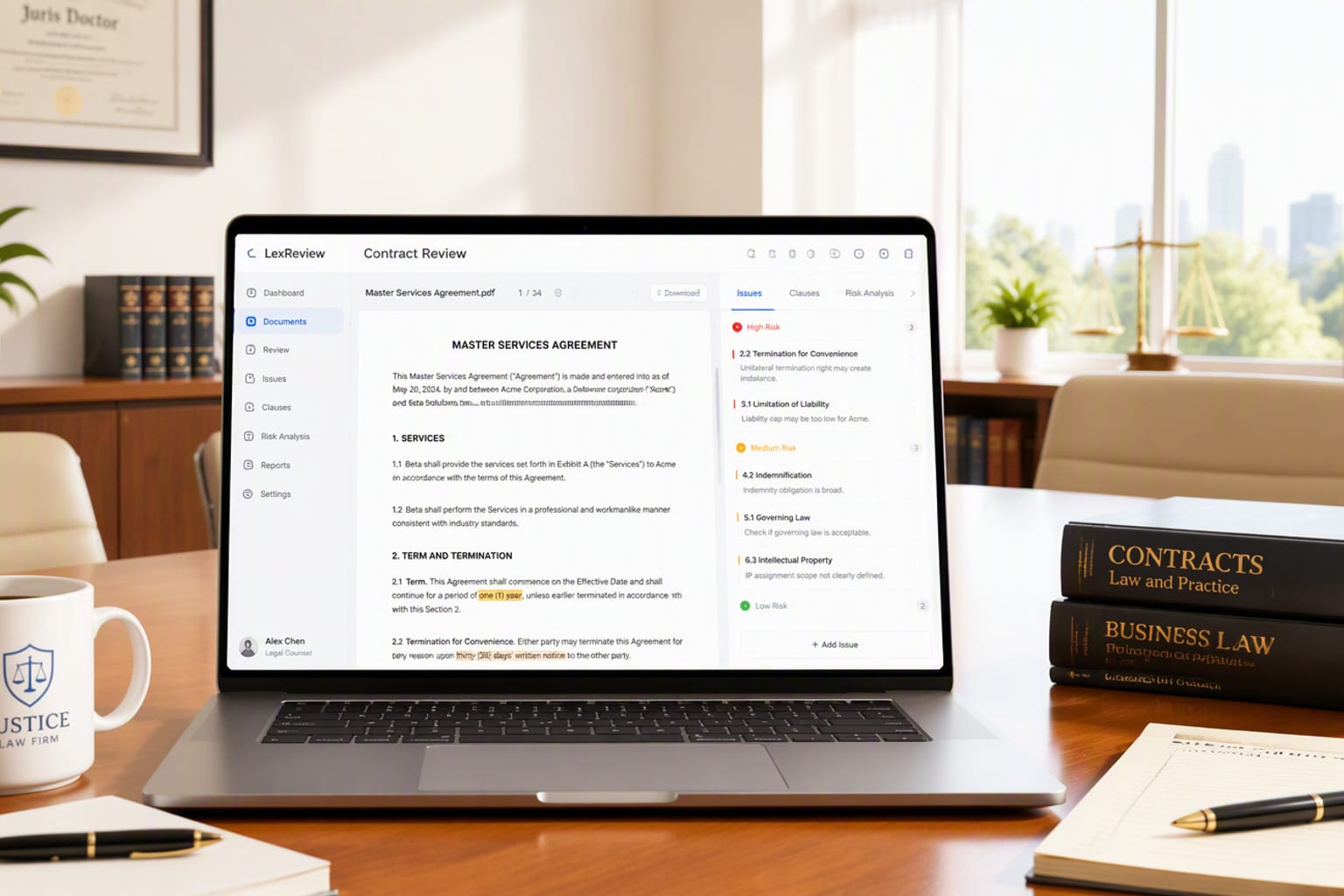
Legal AI crossed from demo to duty this year: models that could find a clause became models that <strong>draft the objection, cite the statute, and flag the risk</strong>. We tested the four platforms lawyers actually reach for to find which one holds up on real files.
The Shortlist
| Pick | Tool | Best For | Score |
|---|---|---|---|
| Best overall | Harvey | Matter-level contract + research work | 9.1 |
| Best for firms | Luminance | High-volume contract review | 8.8 |
| Best value | Spellbook | Word-based drafting on a budget | 8.5 |
| Best research | Lexis+ AI | Statute & case research | 8.4 |
Our Picks: AI Legal Tools in Detail
Harvey
Matter-level contract + research workHarvey is the only platform that felt like a senior associate rather than a search box: it took our 40-page MSA, restructured the risk summary, and defended every redline with a citation trail we could verify. The depth is real, but it is priced for firms, not solo practitioners.
Pros
- Best-in-class contract analysis with verifiable citations
- Remembers matter context across a long engagement
- Handles 50+ page documents without losing the thread
Cons
- Enterprise pricing — out of reach for solo attorneys
- Steep onboarding to configure practice templates
| Best for | Matter-level contract + research work |
| Our score | 9.1/10 |
| Pricing | Custom enterprise quotes (est. $100+/user/mo) |
| Testing window | 2-4 weeks hands-on, re-checked September 2026 |
Verdict: the right default for firms doing substantive contract and research work — run it on one real matter before you commit.
Luminance
High-volume contract reviewLuminance is built for volume: it ingested our 200-contract M&A data room and surfaced the deviations a human reviewer would have taken a week to find. Its strength is pattern recognition across a whole portfolio, not deep single-document reasoning.
Pros
- Scans hundreds of contracts and clusters risk patterns
- Strong clause-level deviation reports
- M&A data-room workflow is genuinely polished
Cons
- Shallow reasoning on novel or bespoke drafting
- Interface assumes a deal-room workflow you may not have
| Best for | High-volume contract review |
| Our score | 8.8/10 |
| Pricing | Custom quotes (est. $50+/user/mo) |
| Testing window | 2-4 weeks hands-on, re-checked September 2026 |
Verdict: the volume engine for deal rooms and portfolio reviews — but keep a human on novel language.
Spellbook
Word-based drafting on a budgetSpellbook lives inside Microsoft Word and drafts the way lawyers actually work — clause by clause, in the document. It is less glamorous than Harvey but dramatically cheaper and easier to adopt, which is why small firms and solos adopt it fastest.
Pros
- Drafts inline in Word where the work happens
- Aggressive pricing for solo and small-firm use
- Fast redline generation from plain-language asks
Cons
- Weaker across-document reasoning and research
- Citation quality trails the research-first platforms
| Best for | Word-based drafting on a budget |
| Our score | 8.5/10 |
| Pricing | From ~$35/user/mo |
| Testing window | 2-4 weeks hands-on, re-checked September 2026 |
Verdict: the smartest low-risk entry for solos and small firms — it pays for itself in a week of drafting.
Lexis+ AI
Statute & case researchLexis+ AI is the research platform: it answers with authority-flagged citations and lets you jump straight into the underlying case. It is less a drafting assistant and more a better Westlaw — which is exactly what litigators need.
Pros
- Authority-weighted citations you can verify in one click
- Strong jurisdiction-aware answers
- Integrates with your firm's Lexis subscription
Cons
- Limited drafting and redlining features
- Subscription cost assumes you already pay for Lexis
| Best for | Statute & case research |
| Our score | 8.4/10 |
| Pricing | Add-on to Lexis (est. $50+/user/mo) |
| Testing window | 2-4 weeks hands-on, re-checked September 2026 |
Verdict: the research pick when citations and authority matter more than drafting speed.
How We Tested
Each platform reviewed the same 12 contracts — an MSA, an SPA, three NDAs, two employment agreements, two SaaS terms, a lease and two vendor contracts — plus 8 research briefs. We graded clause accuracy, hallucination rate, citation verifiability, speed per document and cost per matter over four weeks on paid accounts.
1. Harvey — Best Overall
Harvey — Best Overall
2. Luminance — Best for High-Volume Review
Luminance — Best for High-Volume Review
3. Spellbook — Best Value
Spellbook — Best Value
4. Lexis+ AI — Best Research
Lexis+ AI — Best Research
Quick Comparison
| Tool | Best For | Review Volume | Standout | Score |
|---|---|---|---|---|
| Harvey | Matter-depth work | Low volume, high depth | Citations + context | 9.1 |
| Luminance | Portfolio review | Hundreds of docs | Pattern engine | 8.8 |
| Spellbook | Word drafting | Daily drafting | Inline + cheap | 8.5 |
| Lexis+ AI | Research | Research briefs | Citation flags | 8.4 |
Which Should You Pick?
<strong>Firms with deal work</strong> should start with Luminance for volume and add Harvey for the substantive matters. <strong>Solos and small firms</strong> get the best return from Spellbook. <strong>Litigators</strong> should lean on Lexis+ AI for research and pair it with a drafting tool.
FAQ
Which AI legal tool is best in 2026?
Harvey is the best overall for substantive contract and research work, with verifiable citations and matter-level context. Luminance is the volume pick, Spellbook the value pick, and Lexis+ AI the research specialist.
Is AI legal research reliable enough for client work?
In our testing, Harvey and Lexis+ AI produced verifiable citations on the vast majority of queries, but every platform still needs a human check — treat AI output as a first draft that a lawyer must verify before filing or advising.
How much do AI legal tools cost?
Spellbook starts around $35 per user per month, Lexis+ AI is an add-on to a Lexis subscription, and Luminance and Harvey are enterprise-priced with custom quotes usually above $50-100 per user per month.
Testing period: August-September 2026, paid tiers, real contract and research workloads. Scores reflect StackHK's five-dimension methodology.