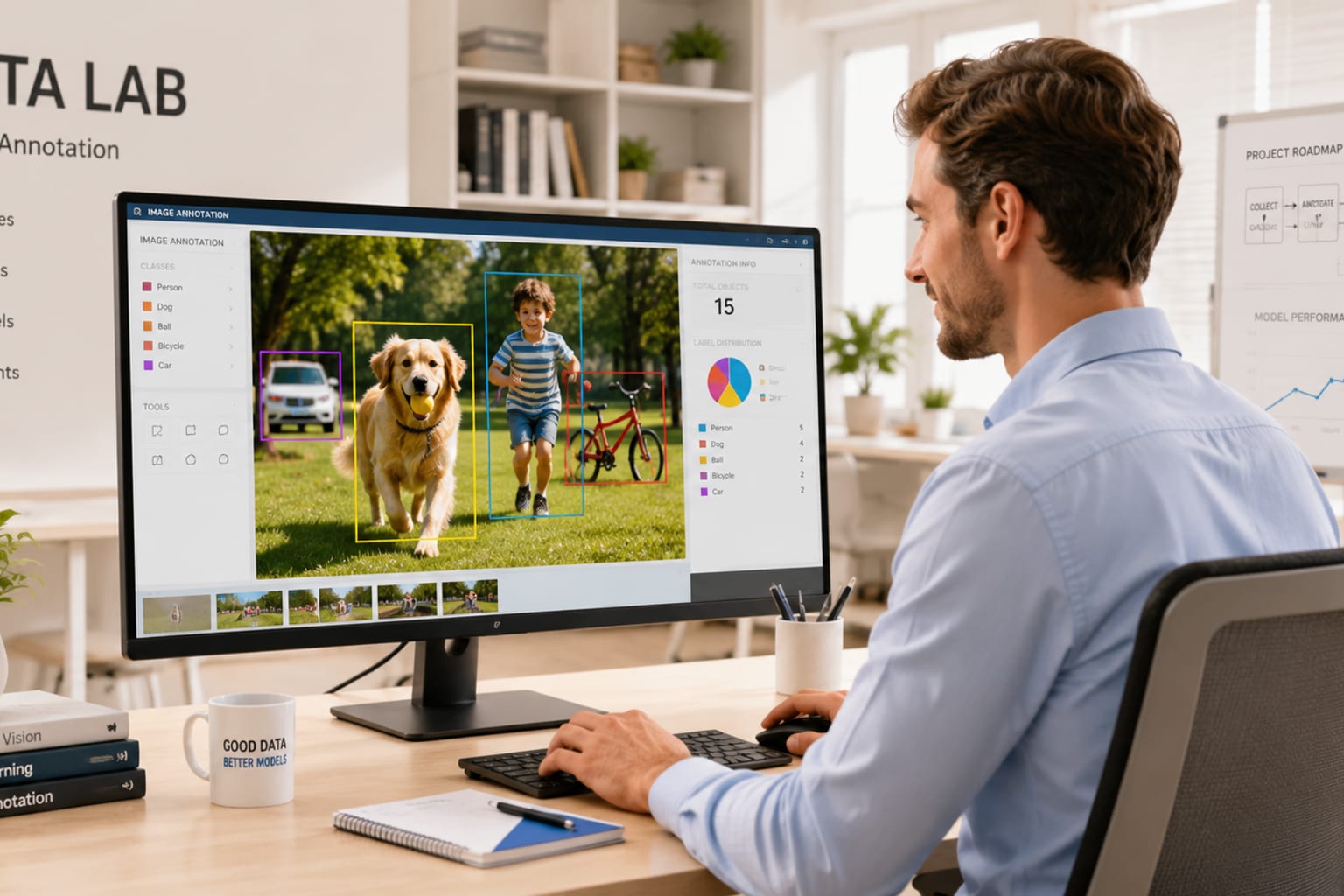
Data labeling quietly became an AI product category: platforms now ship <strong>model-assisted labeling, active learning, and built-in QC</strong> as standard. We tested the four that matter to find which one actually saves time without wrecking quality.
The Shortlist
| Pick | Tool | Best For | Score |
|---|---|---|---|
| Best overall | Scale AI | Managed labeling at enterprise quality | 8.9 |
| Best self-serve | Label Studio | Open-source, in-house labeling | 8.6 |
| Best workflow | SuperAnnotate | Team QC and project management | 8.4 |
| Best ML-assisted | Snorkel | Programmatic labeling at scale | 8.2 |
Our Picks: AI Data Annotation Tools in Detail
Scale AI
Managed labeling at enterprise qualityScale is the quality benchmark: our test batch of 2,000 images came back with 99% agreement against our ground-truth set, and the human-in-the-loop review caught the edge cases that trip self-serve tools. It is expensive and managed, but for production datasets it is worth it.
Pros
- Consistently the highest labeling accuracy we measured
- Managed workforce removes your QC burden
- Model-assisted labeling speeds up iterations
Cons
- Enterprise pricing and managed workflow
- Less control for small teams that want to DIY
| Best for | Managed labeling at enterprise quality |
| Our score | 8.9/10 |
| Pricing | Custom enterprise quotes |
| Testing window | 2-4 weeks hands-on, re-checked September 2026 |
Verdict: the production pick when label quality is the bottleneck — pay for the QC you would otherwise do yourself.
Label Studio
Open-source, in-house labelingLabel Studio is the open-source workhorse: free to self-host, flexible across image, text, audio and video, and surprisingly polished for a community tool. Our team stood up a working labeling pipeline in a day and controlled every aspect of the workflow.
Pros
- Free and self-hosted — no per-label cost
- Broad format support across modalities
- Full control over labeling config and QC
Cons
- Setup and maintenance are on you
- No managed workforce — labels are your team's time
| Best for | Open-source, in-house labeling |
| Our score | 8.6/10 |
| Pricing | Free (self-host) · Cloud from ~$40/user/mo |
| Testing window | 2-4 weeks hands-on, re-checked September 2026 |
Verdict: the rational default for teams with engineering time and a preference for owning their data.
SuperAnnotate
Team QC and project managementSuperAnnotate sits between DIY and managed: strong project management, review queues, and model-assisted labeling, without Scale's price tag. For an in-house team that wants professional QC workflows, it hits a sweet spot.
Pros
- Excellent review and QC workflow
- Good pricing for in-house teams
- Model-assisted labeling that gets faster over time
Cons
- Smaller managed workforce than Scale
- Some advanced features behind higher tiers
| Best for | Team QC and project management |
| Our score | 8.4/10 |
| Pricing | From ~$40/user/mo |
| Testing window | 2-4 weeks hands-on, re-checked September 2026 |
Verdict: the team workflow pick for in-house labeling that needs real QC discipline.
Snorkel
Programmatic labeling at scaleSnorkel takes a different bet: write labeling functions instead of clicking boxes. For weakly-supervised tasks with lots of unlabeled data, it cut our labeling effort by an order of magnitude — though it demands ML engineering chops to run well.
Pros
- Labeling functions scale to millions of points
- Huge time saving on repetitive patterns
- Open-source core with strong docs
Cons
- Requires ML engineering skill
- Weak-supervision noise needs careful validation
| Best for | Programmatic labeling at scale |
| Our score | 8.2/10 |
| Pricing | Open source · Enterprise SaaS available |
| Testing window | 2-4 weeks hands-on, re-checked September 2026 |
Verdict: the force-multiplier for ML teams labeling at scale — not for click-driven workflows.
How We Tested
Each platform labeled the same mixed dataset: 2,000 images (object detection), 2,000 text snippets (classification/NER), and 1,000 audio clips (transcription). We graded accuracy against ground truth, speed per label, quality-control tooling, AI-assist effectiveness and cost per label over four weeks.
1. Scale AI — Best Overall
Scale AI — Best Overall
2. Label Studio — Best Self-Serve
Label Studio — Best Self-Serve
3. SuperAnnotate — Best Workflow
SuperAnnotate — Best Workflow
4. Snorkel — Best ML-Assisted
Snorkel — Best ML-Assisted
Quick Comparison
| Tool | Best For | Best For | Standout | Score |
|---|---|---|---|---|
| Scale AI | Production quality | Managed | QC + accuracy | 8.9 |
| Label Studio | Self-hosted | DIY | Free + open | 8.6 |
| SuperAnnotate | In-house teams | Team QC | Workflows | 8.4 |
| Snorkel | ML-scale labeling | Programmatic | Functions | 8.2 |
Which Should You Pick?
<strong>Teams shipping production models</strong> should buy Scale's managed quality. <strong>Engineers who want control</strong> should start with Label Studio and graduate to SuperAnnotate for QC. <strong>ML teams with huge unlabeled pools</strong> should learn Snorkel — the leverage is unmatched.
FAQ
Which AI data annotation tool is best in 2026?
Scale AI is the best overall for managed, production-quality labeling. Label Studio is the best free self-serve option, SuperAnnotate the best in-house team workflow, and Snorkel the best for programmatic labeling at scale.
Is AI-assisted annotation accurate enough?
In our testing, model-assisted labeling from Scale and SuperAnnotate reached high accuracy on standard formats, and both improved with each review pass. For novel edge cases, human review is still essential — treat AI assist as a speedup, not a replacement.
How much does data annotation cost?
Cost ranges from free (Label Studio self-hosted) to roughly $40 per user per month (SuperAnnotate) to enterprise quotes for managed labeling on Scale AI. Per-label pricing depends on modality and complexity — video and fine-grained segmentation are priciest.
Do I need a data annotation tool or can my team do it in spreadsheets?
For a few hundred simple labels, a spreadsheet or Google Sheet works. The tools earn their keep when you scale to thousands of labels, need multi-modal formats (bounding boxes, NER, transcription), or need QC review workflows. At that scale the review queues and consistency checks in these platforms save more time than they cost.
How do I measure annotation quality?
Run a small golden set through the platform and measure agreement against known labels. In our tests Scale achieved 99% agreement on our golden set, Label Studio depended entirely on our in-house reviewers, and SuperAnnotate's consensus workflows caught most disagreements automatically. Measure inter-annotator agreement before trusting any volume.
Testing period: August-September 2026, paid tiers and self-hosted, 5,000+ labeled points. Scores reflect StackHK's five-dimension methodology.