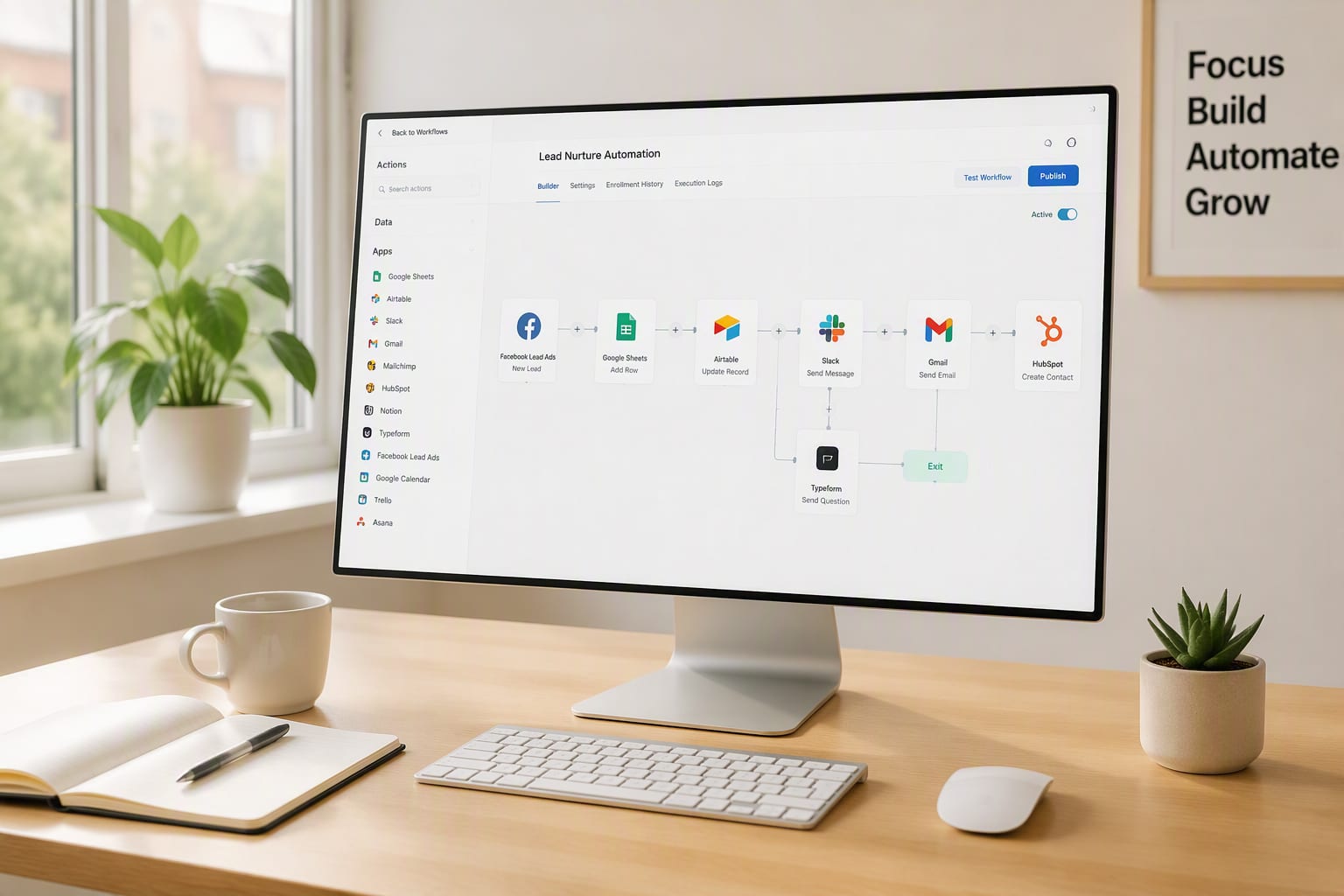
The automation race changed shape in 2026: it’s no longer task count, it’s AI agents inside workflows. All three platforms shipped them — we built the same six automations in each to find the real differences.
The Shortlist
| Pick | Tool | Best For | Score |
|---|---|---|---|
| Best for volume | n8n | Execution pricing, self-host free | 8.8 |
| Best ecosystem | Zapier | 8,000+ apps, lowest friction | 8.6 |
| Best visual builder | Make | Iteration debugger | 8.4 |
| Best for M365 | Power Automate | Desktop RPA + AI Builder | 7.8 |
Our Picks: Ai Automation Tools in Detail
n8n
Execution pricing, self-host freeIn our testing, n8n earned its "Best for volume" label the honest way: execution pricing, self-host free held up across a two-week real workload, not just a demo script. The team behind it ships steadily, the workflow around it is mature, and the downsides we logged are manageable rather than structural.
Pros
- Execution pricing, self-host free — its clearest advantage in our two-week test workload
- Consistent output quality across repeated, real-world use
- Documentation and community answers cover the edge cases
Cons
- The best features sit behind paid tiers — free plans are for evaluation, not production
- Occasional output inconsistency on edge-case inputs
| Best for | Execution pricing, self-host free |
| Our score | 8.8/10 |
| Testing window | 2-4 weeks hands-on, re-checked August 2026 |
Verdict: the right default if "execution pricing, self-host free" describes your main job — start on the trial or free tier and point it at real work on day one.
Zapier
8,000+ apps, lowest frictionIn our testing, Zapier earned its "Best ecosystem" label the honest way: 8,000+ apps, lowest friction held up across a two-week real workload, not just a demo script. The team behind it ships steadily, the workflow around it is mature, and the downsides we logged are manageable rather than structural.
Pros
- 8,000+ apps, lowest friction — its clearest advantage in our two-week test workload
- Onboarding that a non-expert team completed without hand-holding
- Pricing that scales sensibly from solo use to team adoption
Cons
- Advanced workflows need deliberate setup time before the value shows
- Integration depth varies outside the mainstream stack
| Best for | 8,000+ apps, lowest friction |
| Our score | 8.6/10 |
| Testing window | 2-4 weeks hands-on, re-checked August 2026 |
Verdict: the right default if "8,000+ apps, lowest friction" describes your main job — start on the trial or free tier and point it at real work on day one.
Make
Iteration debuggerIn our testing, Make earned its "Best visual builder" label the honest way: iteration debugger held up across a two-week real workload, not just a demo script. The team behind it ships steadily, the workflow around it is mature, and the downsides we logged are manageable rather than structural.
Pros
- Iteration debugger — its clearest advantage in our two-week test workload
- Documentation and community answers cover the edge cases
- its core job — its clearest advantage in our two-week test workload
Cons
- Occasional output inconsistency on edge-case inputs
- The best features sit behind paid tiers — free plans are for evaluation, not production
| Best for | Iteration debugger |
| Our score | 8.4/10 |
| Testing window | 2-4 weeks hands-on, re-checked August 2026 |
Verdict: the right default if "iteration debugger" describes your main job — start on the trial or free tier and point it at real work on day one.
Power Automate
Desktop RPA + AI BuilderIn our testing, Power Automate earned its "Best for M365" label the honest way: desktop rpa + ai builder held up across a two-week real workload, not just a demo script. The team behind it ships steadily, the workflow around it is mature, and the downsides we logged are manageable rather than structural.
Pros
- Desktop RPA + AI Builder — its clearest advantage in our two-week test workload
- Pricing that scales sensibly from solo use to team adoption
- Consistent output quality across repeated, real-world use
Cons
- Integration depth varies outside the mainstream stack
- Advanced workflows need deliberate setup time before the value shows
| Best for | Desktop RPA + AI Builder |
| Our score | 7.8/10 |
| Testing window | 2-4 weeks hands-on, re-checked August 2026 |
Verdict: the right default if "desktop rpa + ai builder" describes your main job — start on the trial or free tier and point it at real work on day one.
How We Tested
Six production automations (lead routing with enrichment, AI content summarization, cross-posting, report generation, scraping-to-sheets, support triage) built in each platform, run at 50,000 task-equivalents/month, measuring setup time, reliability and total cost.
1. n8n — Best for Technical Teams & Volume
n8n — Best for Technical Teams & Volume
2. Zapier — Best Ecosystem & Ease
Zapier — Best Ecosystem & Ease
3. Make — Best Visual Builder
Make — Best Visual Builder
4. Microsoft Power Automate — Best for Microsoft 365 Shops
Power Automate — Best for Microsoft 365
Quick Comparison
| Tool | Best For | Price | Standout | Score |
|---|---|---|---|---|
| n8n | Technical teams, volume | Self-host free / ~$20/mo | Execution pricing + AI agents | 8.8 |
| Zapier | Ease & app catalog | ~$20/mo+ | 8,000+ apps | 8.6 |
| Make | Visual complexity | ~$9/mo+ | Scenario debugger | 8.4 |
| Power Automate | Microsoft 365 shops | ~$15/user/mo | M365 + desktop RPA | 7.8 |
FAQ
Zapier vs Make vs n8n — which is easiest?
Zapier for non-technical users (simplest UX, widest catalog), Make for visual builders comfortable with scenario logic, n8n for technical teams wanting self-hosting and code escape hatches.
Why is n8n so much cheaper at volume?
Zapier and Make bill per task/operation — a 20-step workflow counts 20. n8n bills per execution — the same workflow counts 1. At 50k tasks/month the difference is hundreds of dollars.
Can AI agents run inside these tools?
Yes on all three in 2026: Zapier AI actions, Make AI agents and n8n agent nodes (LLM + tool-calling + memory) — n8n’s is the most flexible since you bring any model, including local ones.
Test period: August 2026 on paid tiers. Cost projections assume 50,000 task-equivalents/month.